The Ungoverned Country: Tolkien's Shire And The Structure Of Power
Was the Shire Tolkien's anarchist utopia? A close reading of his letters and The Lord of the Rings through Kropotkin, Graeber, and James C. Scott.

Among all the characters in J.R.R. Tolkien's The Lord Of The Rings books, Robin Smallburrow is usually not one that is often talked about. Robin's job, as far as we can tell from the text, mainly consists of walking around the country, spreading news and knowing the best places for god beer. According to Sam he "likes the inns more from insode than out". Robin Smallburrow is a Shirriff, the closest the Shire has to a police force. He carries no weapon. He wears no uniform apart from a feather in his hat. His main duty, before things go wrong in the Shire, is rounding up lost cats and dogs and return them to their owners. Before Frodo and his entourage return home near the end of The Lord Of The Rings, having walked out of a war that nearly ended the world, the worst thing this volunteer peace-keeper had to deal with was the increasing number of mushroom thievery.
It's a strange detail to linger on in a story about the fate of Middle-Earth. But it is exactly the kind of detail worth lingering on, because it is very much intentional. Tolkien built an entire society and then quietly decided not to give it a government. Not a bad government, not a struggling government. No government. At least not in any sense we would interpret that word nowadays. And he did this on purpose, for reasons he was very explicit about, in a letter to his son Christopher in the middle of World War 2. A letter written by a man who has since become one of the most widely read authors in English literature and who is not, by any reasonable measure, someone you'd expect to find in the same sentence as Kropotkin or Bakunin.
This essay is about that sentence. About what happens if you seriously consider the idea that the Shire is more than just a backdrop for a war story, but rather that it is Tolkien's most complete portrayal of a society organized around the deliberate absence of rule. And about how closely that portrait , once you look at it structurally rather than sentimentally, resembles arguments that anarchist theorists have been making for more than a century.
Government With A Capital G
In November 1943, Tolkien's son Christopher was eighteen years old and had just been recruited into the Royal Air Force. Tolkien wrote him a long letter, partly consoling, partly furious at the war and the country producing it, and in the middle of it he made a confession that reads almost like a throwaway remark and has since become the single most quoted sentence about his politics:
My political opinions lean more and more to Anarchy (philosophically understood, meaning abolition of control not whiskered men with bombs) – or to 'unconstitutional' Monarchy.
People tend to stop there, because it's a good line and it fits neatly into an argument about Tolkien's supposed political eccentrics. But the sentence that follows is even more interesting, and it's rarely quoted at all:
I would arrest anybody who uses the word State (in any sense other than the inanimate realm of England and its inhabitants, a thing that has neither power, rights nor mind); [...] Government is an abstract noun meaning the an and process of governing and it should be an offence to write it with a capital G or so as to refer to people. [...] and the most improper job of any man, [...], is bossing other men. Not one in a million is fit for it, and least of all those who seek the opportunity.
Tolkien insists that government is nothing more than a process, the act of governing, not a person or anything with actual power or essence.
This is not a complaint about bureaucracy. It reads like a fairly precise philosophical idea, and it happens to be one of the oldest ones in anarchist thought: The insistence that authority becomes dangerous exactly at the point where it stops being an activity that people do to each other and starts being an entity that exists above them, demanding loyalty on it's own account. Mikhail Bakunin spend much of his life crafting a version of this argument, saying that the corrupting force in human affairs isn't any particular ruler but the abstraction of rule itself, the moment powers tops being a relationship and becomes an institution with its own weight. Tolkien, a devout Catholic with no interest in revolutionary politics, arrives at something structurally close to it from an entirely different direction: not through class analysis, but through grammar. Capitalize the word and you've build an idol. Lower the case and it's just a chore someone happens to be doing badly.
At this point Tolkien had spend decades building a world in obsessive detail: languages, genealogies, calendars, the whole apparatus of a fully realized civilization. So when he says his politics lean towards anarchy, we don't have to take his word for it and stop there. We can go check. We can look at the single place in his fiction where he build a society, a people from the ground up according to that instinct, and see what it looks like when philosophy gets cast into a landscape.
That place is the Shire.
A Government Of Almost Nothing

I guess most of you have already read the books or seen the movies and therefore have a general idea of what the Shire is: The pastoral, green homeland of the hobbits, a fertile piece of mostly agricultural land located in the northwest of Middle Earth, bordered by the Brandywine river to the east and the Far Downs to the West.
While the films skip over most of it, the books so give us a more detailed picture on how the Shire actually works, mostly in the prologue chapter from The Fellowship of The Ring - "Concerning Hobbits" as well as the Appendices at the very back of the book. Some more detail can also be found in Tolkien's letters. Tolkien treats the Shire's political structure the way a historian treats a subject's institutions: as a background apparatus, worked out in far more administrative detail than the plot strictly requires, then mostly keeps it offstage.
The Shire was originally not an independent country that just happened to have no king. It was granted to the wandering tribes of Hobbits that came from the east over the mountains by Argeleb II, king of Arthedain, one of the successor-kingdoms of the old Numenorian Realm of Arnor; a land already shaken by war, happy repopulate an abandoned area with a people that is not an enemy. The Shire was mostly independent, but still under royal charter under a real crown. This crown however did not last, and Arthedain was eventually destroyed by the witch-king of Angmar. This is an interesting aspect. The government was not refused, but vacated. And nobody bothered to fill the vacancy, because it turned out it was not necessary. Keep that detail in mind it might matter again later.

There are only a handful of official positions in the Shire. There is the Mayor of Michel Delving, the largest settlement within the Shire, who is elected every seven years at the Free Fair. His primary function, according to Tolkien, is presiding over banquets. The other two civic duties attached to this office are that of the Postmaster, and the head of the Shirriffs. We already talked about the Shirriffs earlier: they were a group of volunteers, usually never more than a dozen in all of the Shire, keeping an eye on what happens around the land. There is also the Thain, which is an position that is tied to the monarchy the Shire is historically a part of. The Thain is the representative of the king and responsible for mustering a militia in times of emergency. This title is hereditary and belongs to the Took family, but by the time of the war of the rings, Tolkien writes, that office had drifted into pure ceremony, invoked so rarely that most hobbits could probably not have told you what it was for. Beneath those functions, doing the actual work of holding society together, are families: managing their own land, their own disputes, their own inheritance, living for generations inside the same enormous houses and holes, with no institution above them exerting meaningful pressure on how they organize their lives.
What is notable here isn't the absence of structure. There is structure: named offices, an election cycle, an occasional formal gathering. What's notable is how thin it is, and how little of the actual texture of hobbit life it touches. Nobody is licensed. Nobody registers with anybody. There is a letter Tolkien wrote reviewing a treatment or a script for a proposed Lord of the Rings Movie in the 50s, where Tolkien heavily opposed the fact that the innkeeper in Bree asked the Hobbits to register their name. This tells you a great deal about how deliberate he had build his world. There is no police or government to register with, he wrote. The very premise of the scene assumed an administrative apparatus that simply didn't exist.
And this is a distinction I want to hold onto. Because it is easy to flatten the idea that "the Shire has almost no government." into "the Shire has no rules". And these two things are not the same. Custom does an enormous amount of work here. Hobbits are famously conservative, bound by tradition and suspicious of anything odd or new (although I do think that this also more complex than it seems, but I might have to write a whole separate post on Hobbit-conservatism). What they are not bound by is command. Nobody above them is telling them to behave in a certain way. The act they way they do because "that is simply what is done", passed down from family to family, generation to generation with no office anywhere empowered to change it by decree. You can call it the anarchist distinction between authority and order: the Shire has plenty of order. It has almost no authority. Those two things getting conflated is, not coincidentally, the mistake often made by people using the word anarchy in modern use (I am looking at you, Christopher Nolan...), and exactly the mistake Tolkien was trying to correct.
The Argument That This Isn't Naive
It would be easy to read all of this as a fairy tale. A fantasy story about happy, simple people who don't need rules, because nothing bad ever happens to them. The political equivalent of a postcard. And for a hundred years this has been more or less the standard critique of societies like it, fictional or real: that statelessness is what you get before civilization arrives, a stage to be grown out of rather than a structure to be chosen.
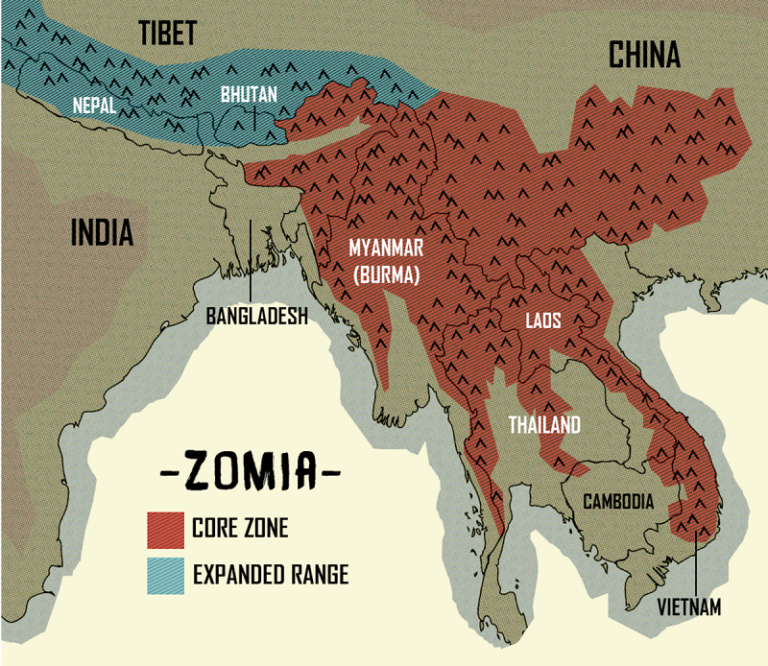
The anthropologist and political scientist James C. Scott spent most of his career arguing the opposite, and his work reframes the Shire in a way that makes it considerably less sentimental. In The Art Of Not Being Governed, Scott studies the highland people of Southeast Asia, a vast , mountainous region he calls Zomia, who spent centuries living within reach of powerful lowland states and simply declined to be absorbed by them. His argument is that this wasn't backwardness but strategy. These were populations who deliberately organized their agriculture, their settlement patterns, even their oral rather than written communication, to remain what he calls "illegible", meaning invisible to the state's tools of taxation, conscription, and control. Because doing so let them keep the benefits of trade with the valley kingdoms without the subordination of being ruled by them. Scott's subtitle calls the whole book "an anarchist history", and he means it in the strict sense. Not a history of chaos, but a history of people who actively refused governance rather than simply lacking it.
“Not so very long ago, however, such self-governing peoples were the majority of humankind. Today, they are seen from the valley kingdoms as “our living ancestors,” “what we were like before we discovered wet-rice cultivation, Buddhism and civilization.” on the contrary, I argue that hill peoples are best understood as runaway, fugitive, maroon communities who have, over the course of two millennia, been fleeing the oppressions of state-making projects in the valleys - slavery, conscription, taxes, corvée labor, epidemics, and warfare.”
- James C. Scott, The Art of Not Being Governed
Read the Shire through that lens and its most stereotypical hobbit-ish qualities (the insularity, the mild contempt for anything happening beyond Bree, the nearly absolute lack of curiosity about the wider politics of Middle Earth) stop looking like provincial charme and start looking like exactly the kind of protective illegibility Scott is describing. Nobody outside the Shire is trying particularly hard to tax it or conscript or conscribe any Hobbits. Their entire cultural posture is one of staying beneath the radar. No grand capital, No standing army. No records anyone in Gondor would think to consult. Gandalf has to spend an not inconsequential amount of time and energy to convince anyone in the wider world that the Shire matters at all. That obscurity isn't an accident. A society this thinly governed survives, in Tolkien's world, largely because nobody powerful has ever had reason to notice it closely enough to govern it for them.
What Holds It Together
If not law, then what?
This is where Peter Kropotkin becomes useful, because his most famous book was written to answer precisely this question about human societies in general, not just fantasy ones. In Mutual Aid: A Factor In Evolution, Kropotkin criticized what he saw as a misreading of Darwin: the assumption that competition alone explains how species and societies survive, by tracing in exhaustive detail, how often cooperation rather than conflict does the actual work of keeping groups alive. He moves from animal behavior through early human tribes to medieval communes and the voluntary associations of his own century, building a picture of society organized around decentralized, freely chosen cooperation rather than the threat of a governing authority. Mutual aid, in his account, isn't a nice supplement to self interest. It is a competing evolutionary strategy, and in his telling, frequently the more successful one.
“In The Descent of Man he gave some powerful pages to illustrate its proper, wide sense. He pointed out how, in numberless animal societies, the struggle between separate individuals for the means of existence disappears, how struggle is replaced by co-operation, and how that substitution results in the development of intellectual and moral faculties which secure to the species the best conditions for survival.”
- Pyotr Kropotkin, Mutual Aid
The Shire runs almost entirely on this logic. There is no market in the modern sense pushing hobbits towards each other through price signals and contracts. There is a dense mesh of custom, favor, and obligation that does the same job without needing enforcement. Farmers help with each others' harvests. Birthdays are occasions for the birthday-hobbit to give gifts away, turning around the transactional logic of a gift economy entirely. The party at Bag's End that opens the whole story is not a business arrangement; it's the kind of enormous, expensive gesture that anthropologists have spent a century trying to explain. David Graeber argues in his work that these kind of acts are actually the bedrock of most human societies, not an exception to how "real" economies work. Graeber's case, developed across Debt and his essays on what he called everyday communism, is that the baseline mode of exchange between people who trust each other has never been formal contract, it's been closer to "from each according to their abilities, to each according to their needs," quietly practiced at the level of the household and the neighbor, whether or not anyone involved would ever use those words.
"[...] This is what makes society possible. There is always an assumption that anyone who is not actually an enemy can be expected to act on the principle of ‘from each according to their abilities …’ at least to a limited extent: for example, if you need to work out how to get somewhere and a person has the ability to give you directions, then they will."
- David Graeber, Everyday Communism
That is the Shire's actual economy, far more than the coin changing hands at the Green Dragon. Authority isn't required to make it run. Trust is.
What Happens When Authority Arrives Anyway
None of this would matter much as an argument if Tolkien had simply left it there. A static, undisturbed world, safe because nothing ever tests it. He didn't. He wrote an entire chapter, late in The Return of The King, whose sole purpose is to test it, and the fact that this chapter exists at all tells you Tolkien understood exactly what kind of society he had built and wanted to see what it would take to break it.
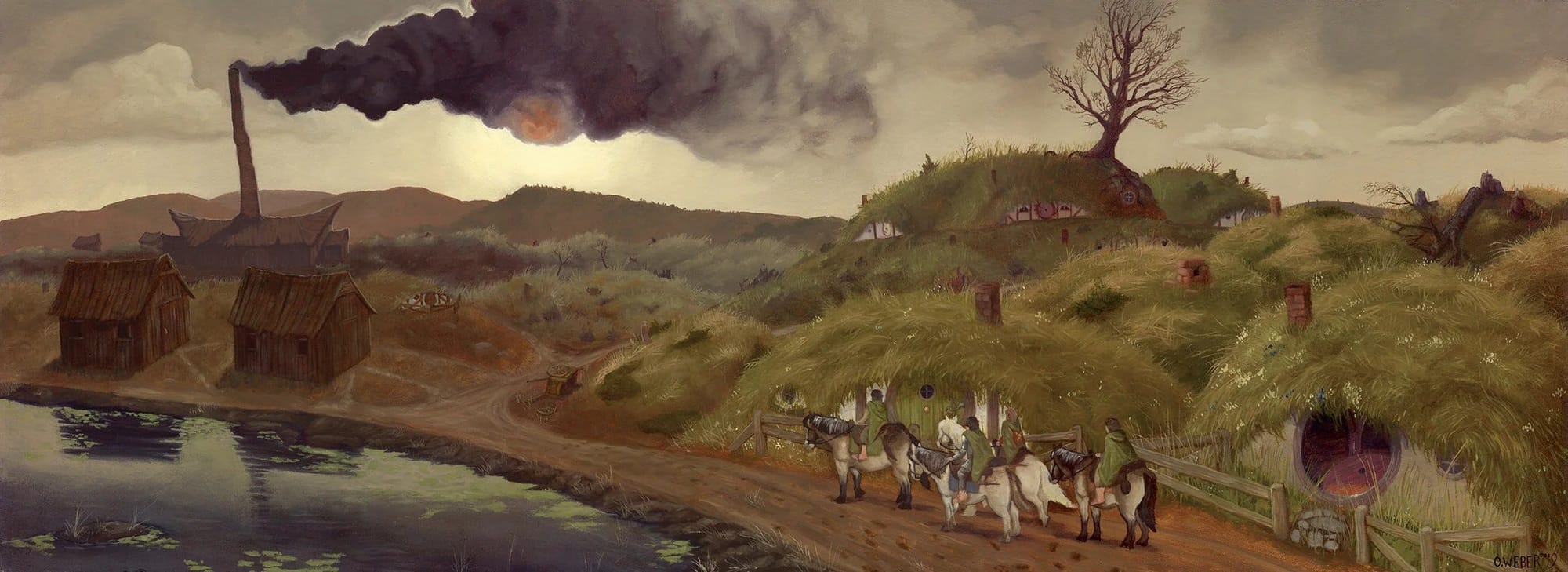
"The Scouring of the Shire" is the chapter where Frodo and his companions come home from saving the world to discover their own homeland occupied. Not by orcs, not by anything grand or mythic, but by a gang of human ruffians running the place on behalf of a fallen wizard hiding under the name Sharkey. What Sharkey's regime brings with it is, pointedly, not violence for its own sake, but government. Suddenly there are Rules, posted and enforced. Suddenly the once-toothless Shirriffs have been multiplied, armed, and turned into an actual instrument of control, complete with checkpoints and arrests for things that have never been crimes before. There's a mill, once a simple gristmill, rebuilt into something larger and louder that pollutes the water and the air in the name of efficiency nobody asked for. Tolkien is not being subtle here, and he wasn't trying to be. He described this chapter as the moral counterweight to the physical quest, the point where the story insists that saving the world means nothing if you can't also protect your own home from exactly the same disease.
What's striking is how the hobbits respond. Nobody petitions anybody. Nobody appeals to a higher authority, because there isn't one nearby to appeal to, and in any case appealing to authority is precisely the reflex this book has spent hundreds of pages declining to model. Instead, word travels farm to farm. A horn is blown, the ancient alarm of the Horn-call of Buckland, unused in living memory. And the Shire simply rises, all at once, without waiting for permission: farmers with pitchforks and billhooks, a scratch militia formed overnight out of people who already knew each other and already trusted each other, needing no one to tell them how to organize because the organizing principle, neighbor helps neighbor, had been sitting there the entire time, dormant, waiting for the one situation dire enough to activate it.
It's worth pausing on this and noticing how closely it resembles a much more contemporary and much less pastoral phenomenon: the black bloc.

Black bloc isn't an organization. Anarchist commentators are emphatic on this point, going back at least to the protests after the 1999 WTO meetings in Seattle, where this tactic first became widely known in the United States. You cannot point to any group and identify them as the Black Bloc, because there's no such entity to point to. It's a tactic that specific people, in a particular moment, choose to adopt: dressing alike, masking identity, and organizing not through chain of command but through affinity groups, clusters of people bound together by pre-existing relationships, the same school or workplace or circle of friends, which is precisely what lets them coordinate without anyone giving orders. It has no leader to arrest, no headquarters to raid, no membership roll to confiscate. It exists only in the moment it's needed and then it dissolves back into ordinary life. Historically, the strategy tends to surface at a very particular kind of trigger point: moments where the state is visibly tightening its grip: the West German Autonomen squatters resisting eviction in the 1980s, protesters at a trade summit experiencing the machinery of global economic governance up close for the first time. It shows up, in other words, exactly when authority becomes newly and unpleasantly legible to people who had been living without much of it.
That's a remarkably precise description of the Shire-muster. It doesn't exist as a standing body. It is summoned into being for one crisis and then, presumably, dissolves; the Hobbits going back to being farmers. It organizes through kinship and neighborliness rather than rank. And it doesn't rise up in the Shire's ordinary, ungoverned state. It rises up in direct response to the sudden, unwanted arrival of exactly the apparatus black bloc tactics are historically deployed against: checkpoints, Rules, an expanded and weaponized police presence, industrial imposition on a landscape that had never needed to accommodate it. Two societies, one imaginary and pastoral, one real and urban, producing the same structural reflex under the same structural pressure. When a population that has organized itself to avoid command suddenly finds command imposed on it from outside, the response isn't to appeal upward for relief. It's to self-organize horizontally and act.
The comparison has a limit, and naming it honestly matters more than pretending it doesn't exist, because the crack in it is more interesting than the parallel. Black bloc theory insists, as a point of principle, that there is no one calling it into being; that's the entire ideological point of the tactic: There is no leader. The Shire-muster is not quite that pure. It's called, technically, by the horn of Buckland and rallied, in the book, under the nominal authority of the Thain and his son, Pippin, by then a Took with a claim to exactly that dormant office. The office had been meaningless for a generation. It becomes meaningful again for about two days, exactly long enough to do the one job it still secretly existed to do, and then presumably drifts back into ceremony once the ruffians are driven out. Which is to say: the muster isn't leaderless in the strict anarchist sense at all. It's a horizontal uprising with a vestigial hereditary hinge left quietly in the door.
The Work That Keeps It Standing
Let's go back to that detail from earlier: The Shire's freedom from rule wasn't a condition of it's founding but happened more or less by chance. After Arthedain fell to Angmar and the line of northern kings went quiet for over a thousand years a vacancy was formed. That vacancy is where the Rangers live. They are the last of that same vanished people, the Dúnedain of Arnor, and they spent centuries traveling the North like a Guerilla force, fighting small, unrecorded skirmishes against orcs, trolls, and wolves wherever those things try to take root. The Shire sits at the very heart of this former kingdom and happens to benefit from the invisible protection the Dúnedain provide. At the Council of Elrond, when Boromir dismisses the Rangers as vagabonds, Aragorn's reply is pointed: he says the North would have known little peace or freedom without them, and that many evil things exist which no wall or sword alone can hold back, only people willing to go out and meet them. It's a description of work: unglamorous, unrewarded, and constant.
"Many evil things there are that your strong walls and bright swords do not stay. You know little of the lands beyond your bounds. Peace and freedom, do you say? The North would have known them little but for us. Fear would have destroyed them. But when dark thing come from the houseless hills, or creep from sunless woods, they fly from us. What roads would any dare to tread, what safety would there be in quiet lands, or in the homes of simple men at night, if the Dúnedain were asleep, or were all gone into the grave?"
- Aragorn at Elronds Council
That word, constant, is like a pivot point. Custom and mutual aid explain how the Shire holds together on an ordinary Tuesday. They don't, by themselves, explain how it survives the arrival of something that has no interest in custom at all, and this is exactly where the Rangers and the muster turn out to be doing the same job on different timescales. The Rangers do it permanently, generationally, over a kingdom's worth of ground, mostly unseen. The hobbits do it once, briefly, on their own doorstep, the instant Sharkey's Rules and checkpoints make the danger visible. Neither is the exception that proves the Shire's peace was really an illusion all along. Both are the same ethic, showing up wherever it's needed, at whatever scale the moment requires.
It's worth hearing how consistently this idea surfaces elsewhere in Tolkien's writing, because it suggests he wasn't improvising it for the Shire specifically. Galadriel describes her own resistance to the Enemy, in Lothlórien, not as a victory won once but as a defeat fought slowly, over and over, without end. The Silmarillion goes further and makes the same idea cosmological rather than personal: Morgoth, in the earliest ages, poured his own corrupting will directly into the substance of the world itself, so that even after he is finally captured and cast out, the marring doesn't leave with him. It's baked into the matter of Arda, permanently, which is the story's own account of why evil can never be finished off for good, only ever fought back to a manageable size, again, by whoever is on watch at the time. Nothing in Middle-earth stays won. It has to be kept, actively, by someone, in every generation, and the keeping rarely looks heroic while it's happening. It looks like Rangers nobody thanks, walking a border nobody sees, or like farmers with pitchforks answering a horn that hasn't been blown in living memory.
That's a genuinely uncomfortable idea and it's worth sitting with rather than smoothing over. A society built on mutual aid can start to sound, in summary, like a society where all that matters is simply cooperation, freely given, low-friction, self-sustaining by nature. The Shire complicates that a little. Custom and neighborliness explain the inner workings, the harvest, the parties. They don't explain what happens when something arrives that has no intention of cooperating back. For that, the story seems to say, cooperation isn't enough by itself; it also needs people willing to notice trouble early and act on it, sometimes for a long time, sometimes without thanks. That is an old argument among anarchists, not something this essay can settle. Kropotkin treated collective self-protection as part of mutual aid rather than opposed to it; others have drawn a harder line between voluntary cooperation and anything that starts to resemble standing vigilance. The Shire doesn't resolve that argument. It just quietly dramatizes both sides of it: a community that runs, day to day, on cooperation, and that turns out, when it matters, to need people willing to keep watch and, eventually, to fight.
If the Rangers' vigilance is labor rather than status, it's worth asking what that makes the King they're waiting for. Not, maybe, a hierarchy in the usual sense at all, a person to be obeyed because of who his father was, but the same job description at a larger scale: the one who watches, who keeps the marring at bay, who does the unglamorous work of holding a line so everyone behind it can afford to forget the line is there. Aragorn spends most of the story not ruling anything, only walking, watching, fighting small fights nobody records. When he's finally crowned, the title reads less like a reward for bloodline and more like a formal acknowledgment of work he'd already been doing, unpaid and unthanked, for decades. Tolkien's kingship, at least here, looks less like an office you inherit and more like a job you keep showing up for, but I guess that could be an essay in and of itself.
Coming Back To Robin Smallburrow
Which brings us back to where we started, with an unarmed hobbit in a feathered cap, mostly occupied with knowing where the good beer is. It's tempting, on a first pass, to read him as a joke, a small, comic detail proving how safe and inconsequential the Shire is. But held up against everything the rest of the book does around him (the letter to Christopher, the offices that barely function, the mutual aid running underneath all of it, the muster that rises the instant something tries to replace custom with command, the Rangers walking silent patrols nobody thanks them for) Robin Smallburrow stops looking like a joke and starts looking like the entire argument in miniature. A police force with nothing to police, in a society that never needed one to hold itself together, until the one week it did, and answered with a horn instead.
That isn't naivety on Tolkien's part. He built it too carefully for that, tested it too deliberately in the one chapter where he lets it break. It's a specific, considered answer to a question he was clearly turning over for most of his life, in fiction and in his letters alike: how little authority can a people actually get away with, if what holds them together instead is each other. The Shire's answer is almost none, but not none. Cooperation gets you the harvest, the party, the mushroom-thief's mild scolding. It doesn't, on its own, get you through the one week when something arrives that has no intention of cooperating back. For that you still need people willing to notice, and willing to act on what they notice, whether that looks like a thousand years of Rangers nobody thanks or four hobbits blowing a horn that hasn't sounded in living memory. Robin Smallburrow's job stays boring for exactly as long as enough people are quietly doing that other, harder job somewhere just out of frame. The week that stopped being true, nobody in the Shire waited to be told what to do. They picked up whatever was in the shed and went.
Bibliography
- Carpenter, H. (ed.) (1981) The Letters of J.R.R. Tolkien. London: George Allen & Unwin.
- Graeber, D. (2010) 'Communism', in Hart, K., Laville, J.-L. and Cattani, A.D. (eds) The Human Economy: A Citizen's Guide. Cambridge: Polity Press, pp. 199–210.
- Graeber, D. (2011) Debt: The First 5,000 Years. Brooklyn, NY: Melville House.
- Kropotkin, P. (1902) Mutual Aid: A Factor of Evolution. London: William Heinemann.
- Scott, J.C. (2009) The Art of Not Being Governed: An Anarchist History of Upland Southeast Asia. New Haven: Yale University Press.
- Tolkien, J.R.R. (1954) The Fellowship of the Ring. London: George Allen & Unwin.
- Tolkien, J.R.R. (1955) The Return of the King. London: George Allen & Unwin.
- Tolkien, J.R.R. (1977) The Silmarillion. Edited by C. Tolkien. London: George Allen & Unwin.


